The Bluster and the Burrow
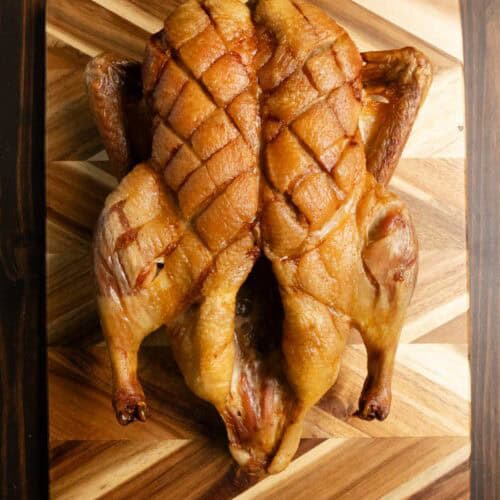
Dry Brined Roasted Duck
This dry brined roasted duck delivers deeply seasoned meat and irresistibly crisp skin using a simple salt cure and controlled roasting method. Once you master the technique, it becomes a foundation recipe you can dress up with glazes, reductions, or serve simply with rendered duck fat potatoes.
Print Recipe
Ingredients
- 6 pound whole duck
- 2 tablespoons salt sea, Himalayan, or Redmond Real
Instructions
Dry Brine the Duck (24-48 Hours Before Cooking)
- Pat the duck completely dry with paper towels. Moisture is the enemy of crisp skin.
- Score the skin in a shallow crosshatch pattern, cutting through the fat but not into the meat.
- Season generously with salt on all sides and inside the cavity.
- Place the duck uncovered on a rack set over a rimmed baking sheet.
- Refrigerate 24–48 hours to dry the skin and season the meat throughout.
Roast the Duck
- Remove the duck from the refrigerator 30 minutes before roasting.
- Preheat the oven to 425°F.
- Place the duck breast-side up on a roasting rack set over a rimmed baking sheet.
- Roast at 425°F for 15 minutes to jump-start fat rendering and tighten the skin.
- Reduce the oven temperature to 350°F and continue roasting for 70–90 minutes.
- Begin checking internal temperature around the 75-minute mark; time varies depending on size.
- Carefully pour off rendered fat once or twice during roasting to prevent pooling beneath the bird.
- Continue roasting until internal temperatures reach:
- Breast: 160–165°F
- Thigh and Leg: 175–185°F
- If the breast reaches temperature before the legs, loosely shield just the breast with foil and continue roasting until the legs are tender.
- If the skin needs additional crisping, increase oven temperature to 425°F for 5–8 minutes at the end, watching closely.
- Rest the duck uncovered for 15–20 minutes before carving. Resting uncovered preserves crisp skin while allowing juices to redistribute.
Carving a Duck
- Remove the legs. Place the duck breast-side up. Gently pull one leg away from the body and slice through the skin between the leg and breast. Bend the leg back until you feel the joint loosen, then cut through the joint to remove the entire leg and thigh in one piece. Repeat on the other side.
- Separate drumstick and thigh (optional). If desired, cut through the natural joint between the drumstick and thigh to portion them separately.
- Remove the breasts. Using a sharp knife, make a long cut down one side of the breastbone, right along the center. Keep your knife close to the bone and follow the curve of the ribcage, gently lifting the breast meat away in one piece. Repeat on the other side.
- Slice the breast for serving. Place each breast skin-side up and slice crosswise into thick slices. Keep the skin intact on each piece for maximum crispness.
- If any juices collect on the board, spoon them lightly over the sliced meat before serving.
Notes
-
- Score only the fat; if you see red meat, you’ve gone too deep.
- Prick thicker fat deposits near the thighs with a needle to encourage even rendering.
- You should see steady dripping during roasting; if fat pools beneath the duck, airflow is blocked.
- Do not baste; added moisture softens the skin.
- Do not flip; flipping tears skin and interrupts rendering.
- If browning too quickly, lower the oven temperature slightly rather than tenting immediately; foil traps steam.
- Rest uncovered; tenting softens crisp skin.
- Save the duck fat. Carefully strain rendered fat through a fine sieve into a heatproof jar. Refrigerate up to 3 months. Use for roasting potatoes, vegetables, searing meats, or confit. Duck fat is liquid gold; do not discard it.
- Save the carcass. After carving, use the bones to make duck stock just as you would chicken stock. It produces a rich, deeply savory broth ideal for sauces and soups.
Nutrition
Calories: 1833kcal | Protein: 52g | Fat: 178g | Saturated Fat: 60g | Polyunsaturated Fat: 23g | Monounsaturated Fat: 85g | Cholesterol: 345mg | Sodium: 2611mg | Potassium: 948mg | Vitamin A: 762IU | Vitamin C: 13mg | Calcium: 51mg | Iron: 11mg
